
Automation
Follows defined rules: move a record, send a notification, synchronise two tools. Ideal when the path is predictable.
Business AI agents / Morocco · France
From the first enquiry to the next approved action. We connect your tools and build AI agents that prepare, organise and follow through—with your team making the decisions that matter.
A free 30-minute conversation. One process. A clear next step.

Choose the right kind of help
Start with the work, then choose the simplest useful system. Our Morocco-based team works in English, French and Arabic, including remote delivery for businesses in France.
Follows defined rules: move a record, send a notification, synchronise two tools. Ideal when the path is predictable.
Finds relevant information and prepares an answer from your approved knowledge. Your team checks the sources.
Coordinates several steps through connected tools. Permissions, approval points and a recovery path define where it can act.
The workflow studio
Choose a process and step through a possible implementation. Each example starts with a request and ends with a reviewed result.
Illustrative examples · sample data · no live actions

Example input
“We need a CRM for a six-person team. Could we discuss importing our contacts and following up on quotes?”
At this step
A website form or shared inbox starts the workflow. Keep the original request available to the team.
At this step
Identify the topic and requested next step. Missing or ambiguous details are flagged rather than invented.
At this step
Find a possible existing contact and prepare a record or task through the agreed integration.
At this step
A team member checks the recipient, extracted information and proposed reply before anything is sent.
At this step
After approval, the configured system records the follow-up and its owner. Failures return to a manual queue.
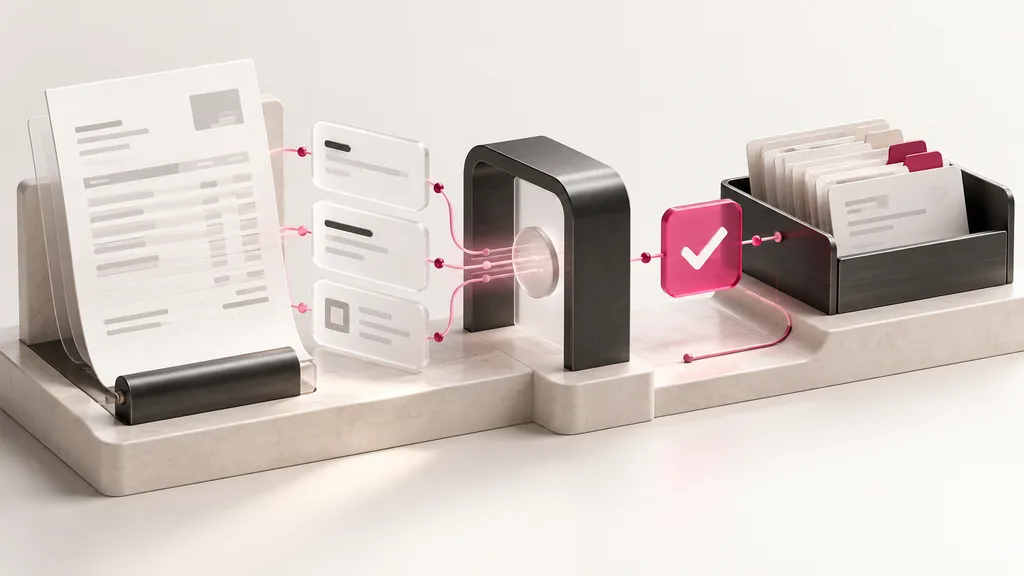
Example input
Sample invoice INV-042 · Atlas Demo · total 2,400 MAD. The supplier record still needs to be confirmed.
At this step
Accept an agreed document format from an approved source. Preserve the file reference and arrival time.
At this step
Read the supplier, date and amounts. Use the document languages and formats your team actually receives.
At this step
Compare totals, look for possible duplicates and flag missing information before preparing an export.
At this step
A responsible person checks the original document and resolves the flagged fields. The system does not approve its own uncertainty.
At this step
Prepare the approved data for the accounting tool or agreed import format. Failed transfers remain visible for manual recovery.

Example input
“How do I request access to the shared project space?” The example policy requires a team manager’s approval.
At this step
Capture the question and check the user’s identity and access scope before searching company information.
At this step
Search only documents the user is allowed to access. Keep a reference to the passages used.
At this step
Prepare a response with the relevant source. If the documents do not answer the question, say so.
At this step
A person reviews sensitive requests and missing or conflicting sources. Include the useful context in the handoff.
At this step
Record the approved reply and the responsible person. Keep the request open if further action is needed.
Built around your tools
We map the connections your process needs before choosing a model or platform. Tool availability and permissions are confirmed during scoping.
Limit access to the records and actions the process actually needs. Keep reading and modifying permissions separate.
Identify the messages, changes and commitments that need a person’s decision before execution.
Missing data, unavailable tools and failed actions go to a review queue with enough context to continue manually.
Agree which actions are recorded, who can review them and how the team investigates an unexpected result.
From an idea to a working process
Map the task, users, tools and constraints. Record current handling time and the errors that matter.
Choose representative examples, define approvals and agree what a successful first version must do.
Compare total handling time, correction rates, exception volume and operating cost—including human review.
Connect the approved workflow, document recovery steps and monitor it before extending the scope.
FAQ
Start with a repeated task, accessible inputs and a clear reviewer: qualifying enquiries, preparing document data or finding internal procedures. If fixed rules solve the task well, ordinary automation may be the better choice.
We first check the APIs, authentication, permissions and limits your tools provide. The pilot specifies the actual connections; the illustrations are examples, not a promise that every product supports every action.
We test with representative French and Arabic inputs from your process. Accuracy depends on document quality, terminology and the selected models. Language requirements belong in the acceptance criteria.
We agree the storage, model providers, access rights and deployment environment during scoping. Data sensitivity and your requirements determine which cloud or hosted options are appropriate.
The estimate depends on the process, integrations, input quality, approvals and deployment requirements. We separate initial development from model usage, hosting and monitoring costs, and agree the schedule after reviewing the scope.
Only within the permissions and approval rules agreed for the workflow. Sensitive actions can require explicit human approval. A manual recovery path is part of the design.
Start with one process
Tell us what repeats, which tools are involved and where a person needs to decide. We will use the free 30-minute audit to identify a useful next step.
Plan your project
How AI agents can qualify enquiries, prepare documents and coordinate business tools, with clear permissions, human approvals and a measurable first pilot.
You do not need a data science team or a big budget to benefit from AI. Here are the first automations that create real value for businesses and organizations.
Your team asks the same questions every day, and the answers are buried in PDFs, procedures and emails. Here is how a private AI assistant answers from your own documents — without sending your data where it should not go.